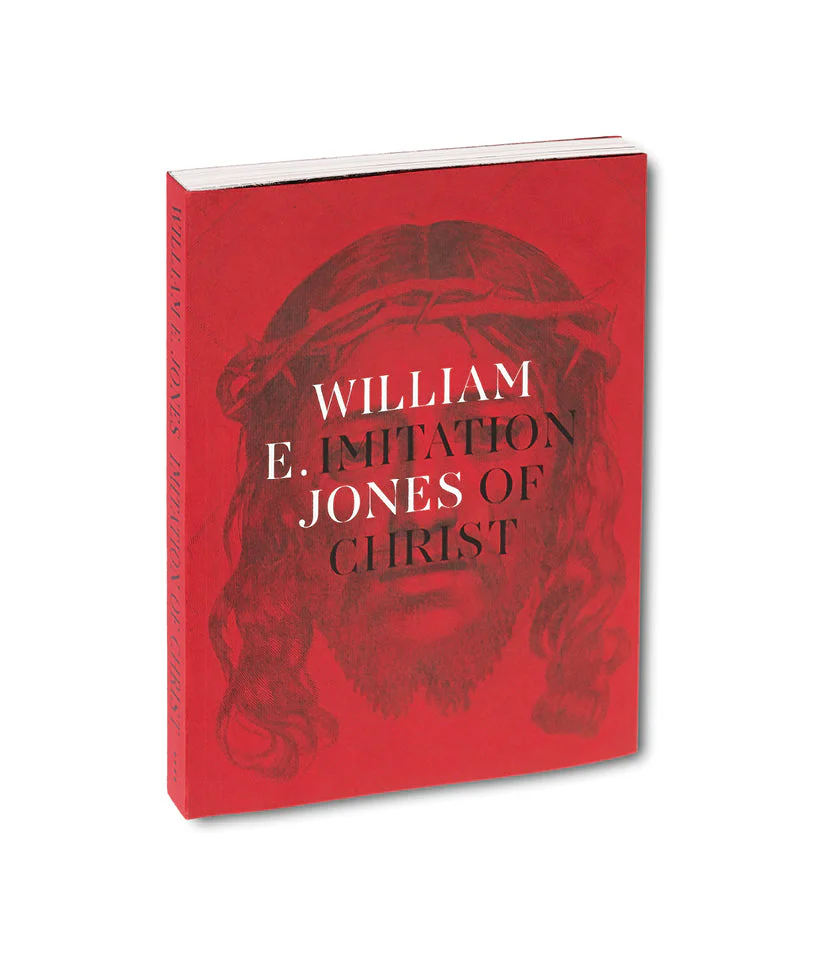
Imitation of Christ
“My Jesus was a real person who did not perform miracles and was not resurrected after death. He was a political revolutionary who, in the face of circumstances that appeared hopeless, succeeded revolutionising the spirit.” William E. Jones
This illustrated essay, by US artist William E. Jones, was born from a collection of images selected from the Hammer Museum archive in LA. Jones unearthed a striking photograph by Pedro Meyer of a wounded guerrilla fighter in Nicaragua during the early 80s. This image became a prism for his selection of a further 45 images from the archive, ranging from Renaissance and Baroque prints to documentary photographs, modern Latin American art and rare books.
This hybrid essay, built from both text and image, confronts two conflicting questions: how is it possible to make an image of revolution, and how is it possible to make a religious image? Examining the parallels between images of revolution and religion, Jones explores connections between images inspired by the life of Jesus across history, and documents that are spawned from moments of revolution: the Paris Commune of 1871, Nicaragua's revolution 1979; the writing of Soviet spy Anthony Blunt in 1940.
The materials were drawn from the collection of the Grunwald Center for the Graphic Arts at the Hammer Museum and from the Charles E. Young Research Library Department of Special Collections, for the Houseguest series with the Hammer Museum where artists are invited to curate an exhibition based on the museum’s and UCLA’s diverse collection.
William E. Jones is an artist and filmmaker born in Ohio and now living and working in Los Angeles. He has made two feature length experimental films, Massillon (1991) and Finished (1997), the documentary Is It Really So Strange? (2004), videos including The Fall of Communism as Seen in Gay Pornography (1998) and many installations. His work has been the subject of retrospectives at Tate Modern (2005), Anthology Film Archives (2010), the Austrian Film Museum and Oberhausen Short Film Festival (both 2011). His group shows include the 1993 and 2008 Whitney Biennials, the 53rd Venice Biennale (2009), and “Untitled (Death by Gun)” at the 12th Istanbul Biennial (2011). He has published the following books: Is It Really So Strange? (2006), Tearoom (2008), Selections from The Anatomy of Melancholy by Robert Burton (2008), Heliogabalus (2009), “Killed”: Rejected Images of the Farm Security Administration (2010), and Halsted Plays Himself (2011).
Product Information
Product Information
Shipping & Returns
Shipping & Returns
Description
“My Jesus was a real person who did not perform miracles and was not resurrected after death. He was a political revolutionary who, in the face of circumstances that appeared hopeless, succeeded revolutionising the spirit.” William E. Jones
This illustrated essay, by US artist William E. Jones, was born from a collection of images selected from the Hammer Museum archive in LA. Jones unearthed a striking photograph by Pedro Meyer of a wounded guerrilla fighter in Nicaragua during the early 80s. This image became a prism for his selection of a further 45 images from the archive, ranging from Renaissance and Baroque prints to documentary photographs, modern Latin American art and rare books.
This hybrid essay, built from both text and image, confronts two conflicting questions: how is it possible to make an image of revolution, and how is it possible to make a religious image? Examining the parallels between images of revolution and religion, Jones explores connections between images inspired by the life of Jesus across history, and documents that are spawned from moments of revolution: the Paris Commune of 1871, Nicaragua's revolution 1979; the writing of Soviet spy Anthony Blunt in 1940.
The materials were drawn from the collection of the Grunwald Center for the Graphic Arts at the Hammer Museum and from the Charles E. Young Research Library Department of Special Collections, for the Houseguest series with the Hammer Museum where artists are invited to curate an exhibition based on the museum’s and UCLA’s diverse collection.
William E. Jones is an artist and filmmaker born in Ohio and now living and working in Los Angeles. He has made two feature length experimental films, Massillon (1991) and Finished (1997), the documentary Is It Really So Strange? (2004), videos including The Fall of Communism as Seen in Gay Pornography (1998) and many installations. His work has been the subject of retrospectives at Tate Modern (2005), Anthology Film Archives (2010), the Austrian Film Museum and Oberhausen Short Film Festival (both 2011). His group shows include the 1993 and 2008 Whitney Biennials, the 53rd Venice Biennale (2009), and “Untitled (Death by Gun)” at the 12th Istanbul Biennial (2011). He has published the following books: Is It Really So Strange? (2006), Tearoom (2008), Selections from The Anatomy of Melancholy by Robert Burton (2008), Heliogabalus (2009), “Killed”: Rejected Images of the Farm Security Administration (2010), and Halsted Plays Himself (2011).